
Tuesday, September 1, 2015


Thursday, August 20, 2015
Banking Ethics
One is tempted to say that Banking Ethics is an oxymoron. Given their role in crashing the world economy on the tax payers dime in 2008 and leaving millions to suffer ever since that would seem an accurate observation. Add a host of other sins and it would seem to be an understatement.
We have bankers laundering dirty money of every kind, telling the drug cartels, “If it’s cash we’ve got your stash.” We have bankers scheming to fix international interest rates and help rogue nations avoid sanctions. We have bankers recruiting tax cheats. Our Justice Department maintains that sending these criminals to jail might jeopardize the world economy as if they haven't already done that as part of their pursuit of profits and bonus bucks. Instead, we give them fines they see as no more serious than a parking ticket. Yet, just let any of these banks have a couple of bad quarters and watch their top guy get the boot. Executive turnover is an everyday thing; to imagine that bankers are too important to jail is madness.
Yes, many of our bankers -especially those atop the monster banks- are master criminals, however, the vast majority are ethical individuals trying to do their job in a business sector that seems rigged against them. It is long past time that we root out the bad guys, that we remove the incentives to deceive and to gamble with the taxpayer's funds standing by to cover their losses.
We must reverse the deregulation disaster of the last several decades. We must create an atmosphere that allows the vast majority of bankers to do the job they long to assume. We must never allow banks to become "Too Big to Fail." We must rid our authorities of the notion that anyone, especially bankers are "Too Big to Jail."
One is tempted to say that Banking Ethics is an oxymoron. Given their role in crashing the world economy on the tax payers dime in 2008 and leaving millions to suffer ever since that would seem an accurate observation. Add a host of other sins and it would seem to be an understatement.
We have bankers laundering dirty money of every kind, telling the drug cartels, “If it’s cash we’ve got your stash.” We have bankers scheming to fix international interest rates and help rogue nations avoid sanctions. We have bankers recruiting tax cheats. Our Justice Department maintains that sending these criminals to jail might jeopardize the world economy as if they haven't already done that as part of their pursuit of profits and bonus bucks. Instead, we give them fines they see as no more serious than a parking ticket. Yet, just let any of these banks have a couple of bad quarters and watch their top guy get the boot. Executive turnover is an everyday thing; to imagine that bankers are too important to jail is madness.
Yes, many of our bankers -especially those atop the monster banks- are master criminals, however, the vast majority are ethical individuals trying to do their job in a business sector that seems rigged against them. It is long past time that we root out the bad guys, that we remove the incentives to deceive and to gamble with the taxpayer's funds standing by to cover their losses.
We must reverse the deregulation disaster of the last several decades. We must create an atmosphere that allows the vast majority of bankers to do the job they long to assume. We must never allow banks to become "Too Big to Fail." We must rid our authorities of the notion that anyone, especially bankers are "Too Big to Jail."
Tuesday, November 11, 2014
Armistice Day
At the eleventh hour of the eleventh day of the eleventh month in 1918, my father sat in a trench in France as the guns fell silent in Europe. He had returned to duty after a brief treatment for a huge mustard gas burn on his back. He was the only one of his comrades left alive after that attack.
The others couldn't withstand the searing pain when the gas penetrated their rain soaked uniforms. They died when they stood and began to tear off their clothing. Father said that it felt like a blowtorch on his back. The giant scar itched every moment of every day for the rest of his life.
Walt
or Mack as he was called was extremely reluctant to discuss combat as
all who experience it are. He sat for a photo in his uniform when he
returned.
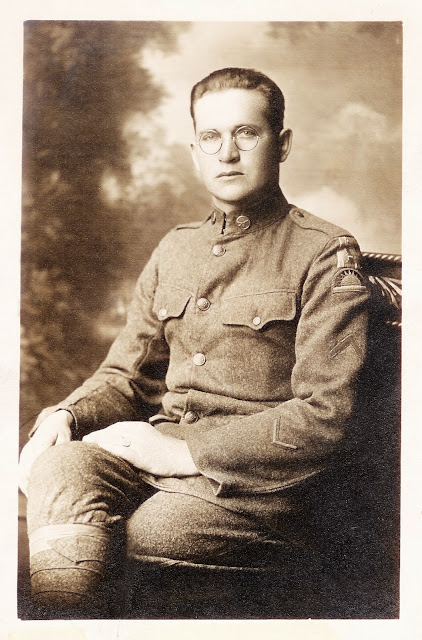

His uniform jacket hangs in my closet. It fits me perfectly. Wearing it
on occasions like this helps connect me with this good man. I was born
-his only child- late in his life; I was just 26 when he died. I wish he
had lived longer.
This date (he called it Armistice Day) was understandably important to him, as it is to me.
Thursday, October 9, 2014
Thomas Eric Duncan died because he went to the aid of a pregnant teen who collapsed in the street near his home. He took her to three medical facilities that turned her away and was left with no choice but to return and carry her in his arms to her home. A less compassionate person would have stood back; others in the village did just that.
He had his ticket for a long planned trip to America to marry the love of his life. We'll never know if he might have done less - or been more cautious- had he known that the teenaged girl had Ebola, none of his neighbors knew, the taxi driver didn't suspect; Duncan acted as the good man he was.
He had no symptoms when he boarded the plane. Days after he arrived and displayed symptoms he went to a hospital where he disclosed that he was from an Ebola hotbed. The nurse who saw him ignored the importance of that disclosure. For a time the hospital claimed the doctor who saw him didn't know of that disclosure - a nonsensical lie - but in spite of that huge red flag they sent Duncan home with a Z-pack.
We will never know if Thomas Eric Duncan might have lived had the hospital personnel paid attention to their job and began treatment days earlier. We know that the world has lost a good and compassionate human being, Thomas Eric Duncan. Who knows what he might have achieved and contributed to our nation if he had lived, we just know that America failed him.
Wednesday, June 4, 2014
Published CommPro.biz 2014.06.03
Credit Suisse -
You Can’t Put A
Bank In Jail
Credit Suisse, a Swiss monster bank apparently has copped a
plea with the United States Justice Department. This story has been seeping out
since United States Attorney General Eric
Holder declared several weeks ago that no bank is “too big to jail.” While that
sounds tough, the fact is that banks do not go to jail, people go to jail. And
in this case nobody is going to jail. Justice is trumpeting the $2.6 billion
dollar fine they got Credit Suisse to cough up. That sounds like a lot but it’s
next to nothing given their massive criminal activity.
Credit Suisse sent hustlers out to recruit ultra-rich Americans.
They arranged trips to Switzerland
to open a secret Swiss bank account. Now, we’re not talking about a handful of
rich folks; there are more than 20,000 Americans who are said to have as much
as $12 billion stashed overseas with Credit Suisse. In that light the bank got
off really easy. Meanwhile it’s business as usual at the bank; in fact their
stock went up one percent the day this deal came out.
How are the Credit Suisse hustlers who recruited the ultra-rich
and guided them into this tax racket anything but crooks? If they recruited rich
Americans to show them how to hide their bucks from the IRS in secret Swiss
bank accounts, that sounds to us like they conspired to defraud the United States
government. If there are billions overseas still hidden away in Credit Suisse
accounts, how have the American people been served?
Why aren’t the Americans who lapped up this deal being named?
Why aren’t they being charged? Why aren’t the bankers who recruited them being
charged? Why aren’t their bosses who sent them out to recruit tax cheats being
charged? And their bosses’ bosses and the CEO of the bank, Brady Dougan, why aren’t they all being charged? Are we to
believe Credit Suisse had a crew of hustlers vacuuming
American bucks – as much as $12 billion – into secret bank accounts and Dougan
didn’t know? It isn’t like he is a stranger in our land; Brady Dougan is a US citizen. One wonders, does
Dougan have a secret Swiss account?
We have bankers laundering dirty
money of every kind, telling the drug cartels, “If it’s cash we’ve got your
stash.” We have bankers scheming to fix international interest rates and help
rogue nations avoid sanctions. And now adding recruiting tax cheats to their litany
of bad behaviors. AG Eric Holder maintains that sending these criminals to jail
might jeopardize the world economy. Really? Instead we give them fines that
they see as no more serious than a parking ticket. Yet, just let any of these
banks have a couple of bad quarters and watch their top guy get the boot.
Executive turnover is an everyday thing; to imagine that bankers are too
important to jail is madness.
Tuesday, May 20, 2014
Published CommPro.biz 2014.05.20
Hacking the Royals
Shakespeare has left us with a picture of the Danes -especially
members of the Royal family like Hamlet- as rather pouty young guys. In fact
they are really nice people and Denmark
is a very nice (if a bit chilly) small nation, most famous for design and Legos.
Scandal is not a word you expect to connect to the Danes at all. However, last
Tuesday (2014.05.14) they were hit with what they consider a “Major media
scandal.”
It seems that back in 2008 the younger son of the queen was
taking a second try at marriage. Joachim Holger Waldemar Christian, the Count of Monpezat,
was married to Marie Cavallier a Parisian advertising executive. While their
wedding was quite public their honeymoon plans were not. You can imagine their
surprise when a reporter from a Danish celebrity magazine turned up on their
flight home. The reporter got his interview (he says they answered his
questions politely) and until last week the Prince and his bride had no idea
how he found them. Therein lies the scandal, the magazine paid off a source who
hacked the credit card used to book the flight. This revelation has triggered a
firestorm of legal and regulatory activity in Demark.
Alas Denmark’s “Tuesday” in the media scandal spotlight was
not to last, the very next day Clive Goodman, one of Rupert Murdoch’s editors
told a court in London that he hacked the phones of Prince William, Kate
Middleton and Price Harry over 200 times. That was in 2007 the year before Goodman
was caught and jailed for this and similar “research” efforts. Perhaps the Danes
picked up the Royal Hack idea from the Murdoch pond scum school of journalism.
While this is all great fun, we need to look at the serious
side. There is more to our right to know than gossip and much more to
journalism than the Murdoch minions’ petty view imagines. A British Parliamentary
Committee found that “Rupert Murdoch is not a fit person to exercise the
stewardship of a major international company”. Clive Goodman and others steeped
in Murdoch’s duplicitous culture have felt the weight of the law. The question
remains, why have they not felt it in America?
Rupert Murdoch is a United States citizen; he had to
become an American before he could own radio and television stations in our
country. It’s one thing for him to be deemed “not a fit person” in Great Britain, in America it’s the law. Bribing
foreign officials is illegal. Murdoch’s operations in Great Britain
routinely bribed law enforcement officers and other officials. Murdoch should
be stripped of his American broadcast stations. He should be charged and tried
for his illegal activities along with his henchmen who flaunt America’s laws.
The Danes are taking care of their business, it’s time for America to take of ours.
Tuesday, May 13, 2014
Published CommPro.biz 2014.05.13
A New Gilded Age?
By: W.T. “Bill” McKibben
In 1873 Mark Twain and Charles Dudley Warner
published The Gilded Age: A Tale of Today.
The name stuck, roughly covering the period from the end of the Civil War to
the Trust Busting Teddy Roosevelt era. At its height around 1900 the top 10% percent
of Americans soaked up about half the income with the top 1% getting about 40%
of that amount. That left the 90% to divvy up the other half, slim pickings at
best.
After Teddy Roosevelt leveled the playing field and the labor
movement spread the bucks around even more, income inequality was not as big an
issue. The two World Wars that devastated the infrastructure of nearly all
developed economies, except the United States
gave America
a running start during most of the last 100 years. However, toward the end of
the 20th Century and into the early part of the 21st the
rich and powerful began to tilt the table in their direction again. The laws
put in place following the Great Depression that protected little folks fell to
a “Deregulation Era.” Enter a new Gilded Age.
Tax loopholes and corporate subsidies added in to tilt the American
landscape toward the super rich. So we find ourselves just where we were in the
last Gilded Age, half the bucks going to the top 10% and 40% of that going to
the top 1%. The middle class has been devastated and the poor are scrambling to
keep their heads above water. Basically a set of social problems covered by a
“thin gold gilding” the same outlook seen by Twain and Warner in 1873.
That leaves some questions. Is it morally and ethically acceptable?
Is it financially sustainable? Teddy Roosevelt didn’t think it fit inside any
of those parameters. He saw it as just wrong. It isn’t as if this new Gilded
Age came about through the efforts of those who are benefiting. When the laws
of the land are twisted to give any group an advantage it’s just plain wrong.
What’s really bad about the current situation is that the recession so many are
struggling to crawl out from under was triggered by reckless bankers who we had
to bailout to avoid a major depression. They are now doing better than ever and
the stock market is booming.
A recent Pew
Research Center
study shows that almost all Americans understand how the makeup of this Gilded
Age came to be. Given an open-end question the answers came in all over, however,
two out of five pinpointed loopholes and our tax system, followed by all the
usual suspects, government policies, corporate influence, greed, etc., etc.,
etc. Although remarkably 10% believe that a poor work ethic and reliance on
government handouts created inequality; really! A gilded age is unsustainable;
it’s bad for the poor and for the rich.
Subscribe to:
Posts (Atom)





 Posts
Posts

